
El Monte Sources for Previous Residents
An El Monte address history needs separate evidence. The Assessor fixes the parcel and legal description. The recorder shows title transfers. Directories and census schedules add published or enumerated households. Permits and maps date change. Probate and obituaries explain gaps. No source is complete, so test an absence against another record.
| Source | Years It Covers | Where Held | What It Shows |
|---|---|---|---|
| RR/CC recorded instruments | Holdings stated since 1850; detailed pages also use 1851 | Norwalk counter and copy order | Parties, dates, liens, and legal descriptions |
| Assessor parcel data | Current and prior-roll fields vary | LA County Assessor Portal | AIN, situs, values, characteristics, building dates |
| City and reverse directories | Exact El Monte run uncertain; LAPL holdings listed below | LAPL, LA County Library, museum | Occupants, occupations, and address order |
| Federal census | Through 1950 public in 2026; 1960 due in 2032 | NARA and library databases | Households, relationships, ages, occupations, place |
| Permits, USGS, and Sanborn maps | USGS 1926, 1948, 1953, 1966; Sanborn range 1867-1970 | El Monte divisions, LAPL, and LOC | Alterations, construction context, footprints, and street change |
Start with parcel data and the AIN. Use directories and census schedules for older households, the recorder for title, and probate or obituaries for death and inheritance gaps.
The Los Angeles County property-tax portal is a useful entry to the county's parcel, assessment, and tax functions.
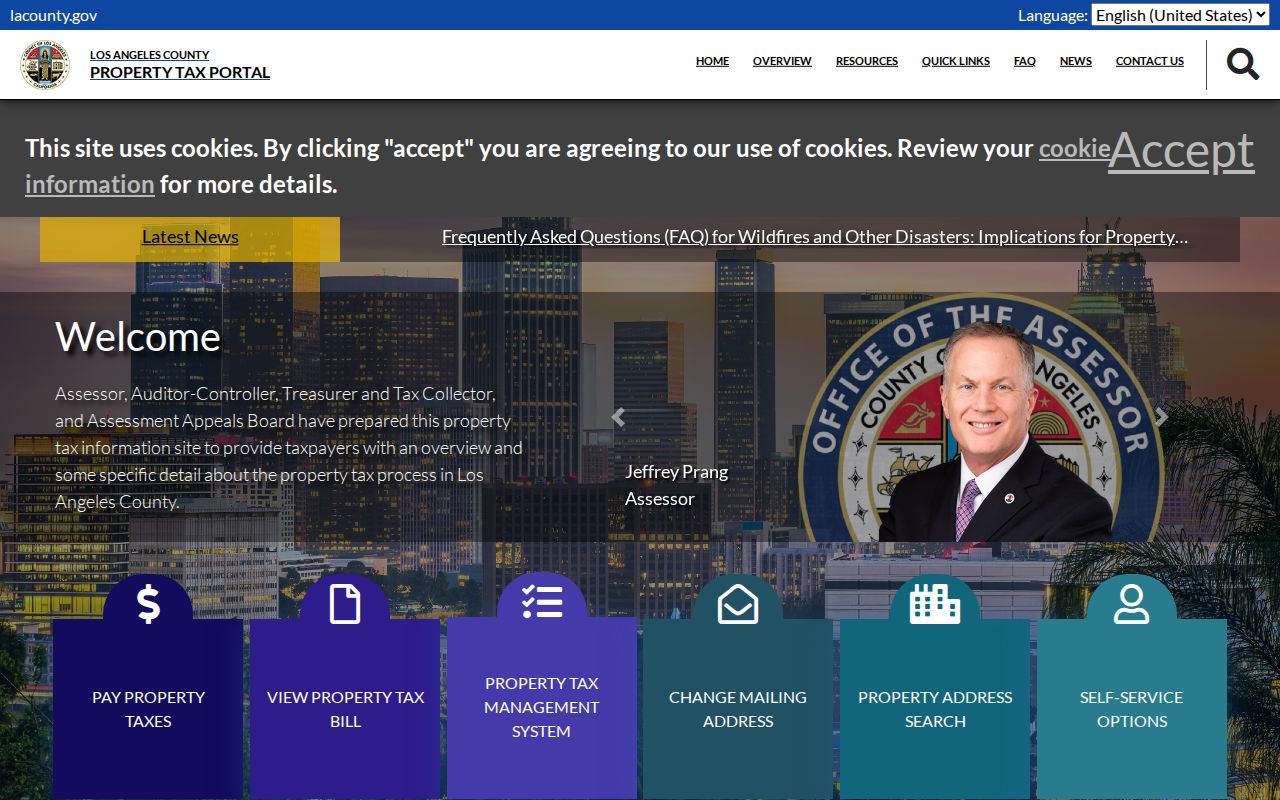
That county doorway helps tie a street description to the parcel record before older names are sought.
El Monte Previous Residents: Fix the Parcel
Search the Los Angeles County Assessor Portal by situs address or 10-digit AIN. Record the AIN, legal description, parcel type and status, use code, tax-rate area, exemption, values, base year, land and building square feet, units, beds or baths, year built or effective year, and map. These fields stabilize a later deed search when street text changes.
The public parcel card suppresses owner and mailing address. It describes land, not a resident list. Situs is the physical location; a mailing address receives tax notices. Neither proves occupancy or names a full household.
The LA County Assessor parcel-detail example shows the kind of AIN, situs, use, value, map, and building fields that can anchor a house history. Use those parcel facts to test each later instrument, especially when a person held more than one parcel or an old street number no longer matches.
El Monte Previous Residents: Deed Trail
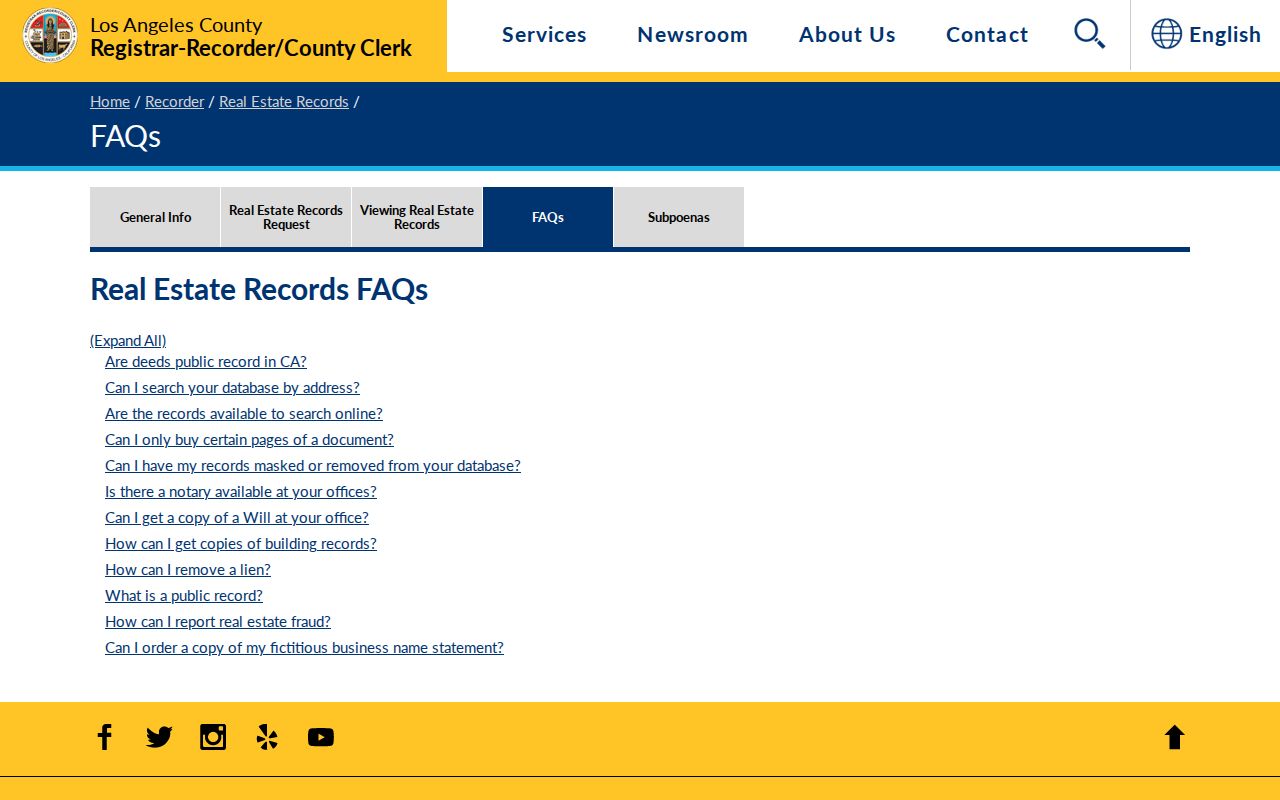
Recorded real-estate documents in Los Angeles County are indexed by grantor, grantee, and recording year. The RR/CC does not offer a public online name or address index for this work, so the address must first become a parcel, legal description, and known party. A deed chain traces title. It does not create a complete list of past occupants.
- Write down the current AIN and legal description from the Assessor parcel record.
- Find a known recent deed or named owner, with an approximate recording year.
- Read the deed's grantor, grantee, document number, date, and legal description.
- Search the earlier seller as a grantee, then repeat the seller-to-buyer pivot backward.
- Compare each link with the legal description and AIN before accepting it as the same parcel.
- Grantor and grantee
- The grantor transfers an interest. The grantee receives it in the recorded instrument.
- Chain of title
- The linked sequence of recorded transfers that connects one title holder to an earlier holder.
- Legal description
- The tract, lot, block, or other land description used to identify the parcel when street text is unclear.
- Criss-cross directory
- A reverse directory that may reorder names by street and number, if a local edition was held.
The Los Angeles County Registrar-Recorder/County Clerk recorder page explains the office route for real-estate records and related county services.
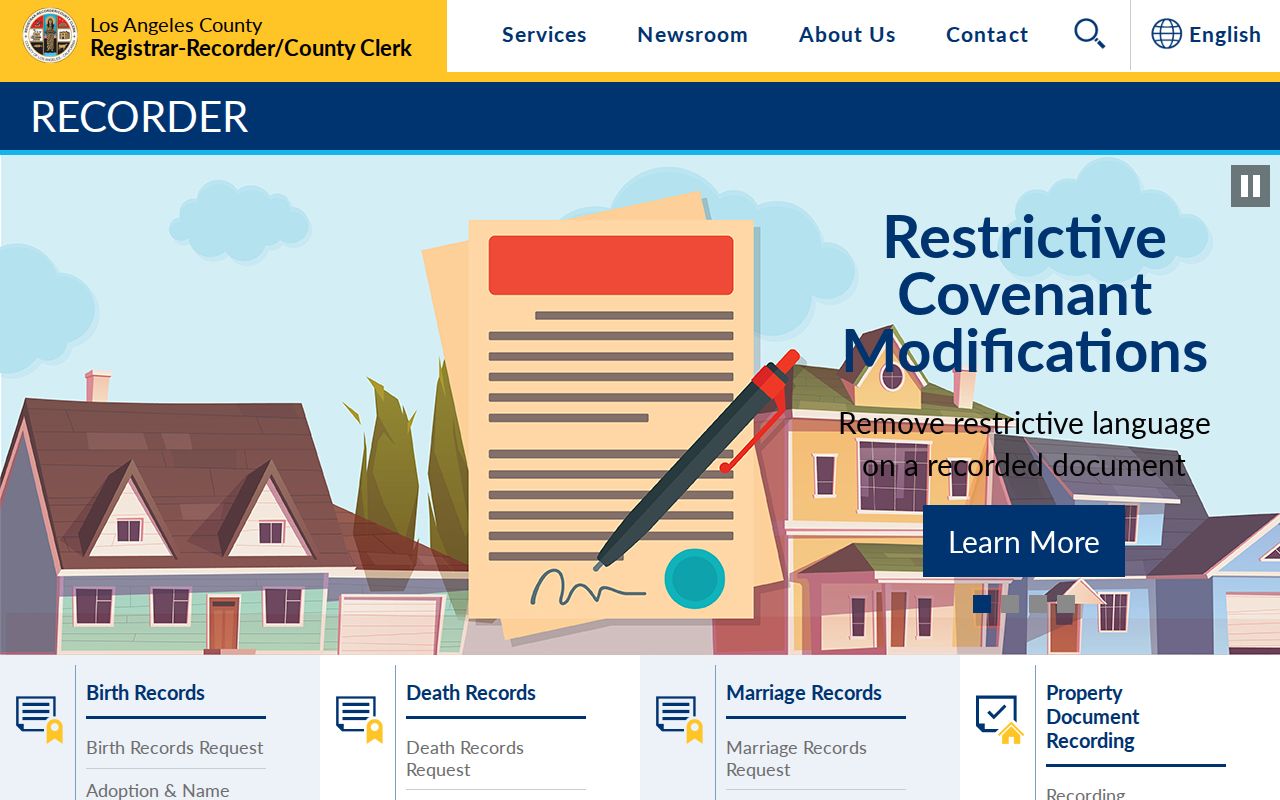
The recorder channel belongs after the parcel step, because an address alone cannot run the county's name-and-year index.
El Monte’s 1850 Recorder Quirk
Los Angeles County says real-estate holdings are maintained since 1850, while detailed guidance describes index access beginning in 1851. The index is not public online and cannot be searched by street address.
At Norwalk, 1851-1957 indexes are on the lower level and 1958-present material is on the second floor. Search at the counter, order a known document, or mail the title, names, and year range. Telephone index searches are not accepted. Processing can take up to 20 working days.
The RR/CC explanation of the recorder index is the source for the no-address, grantor, grantee, and year rules.
Norwalk headquarters is 12400 Imperial Highway, Norwalk, California 90650. RR/CC is 800-201-8999, option 3 for recorded real-estate records, and recorder@rrcc.lacounty.gov. Bring spelling variants, an approximate year, a document number, and the legal description.
The RR/CC contact page gives the Norwalk request route.
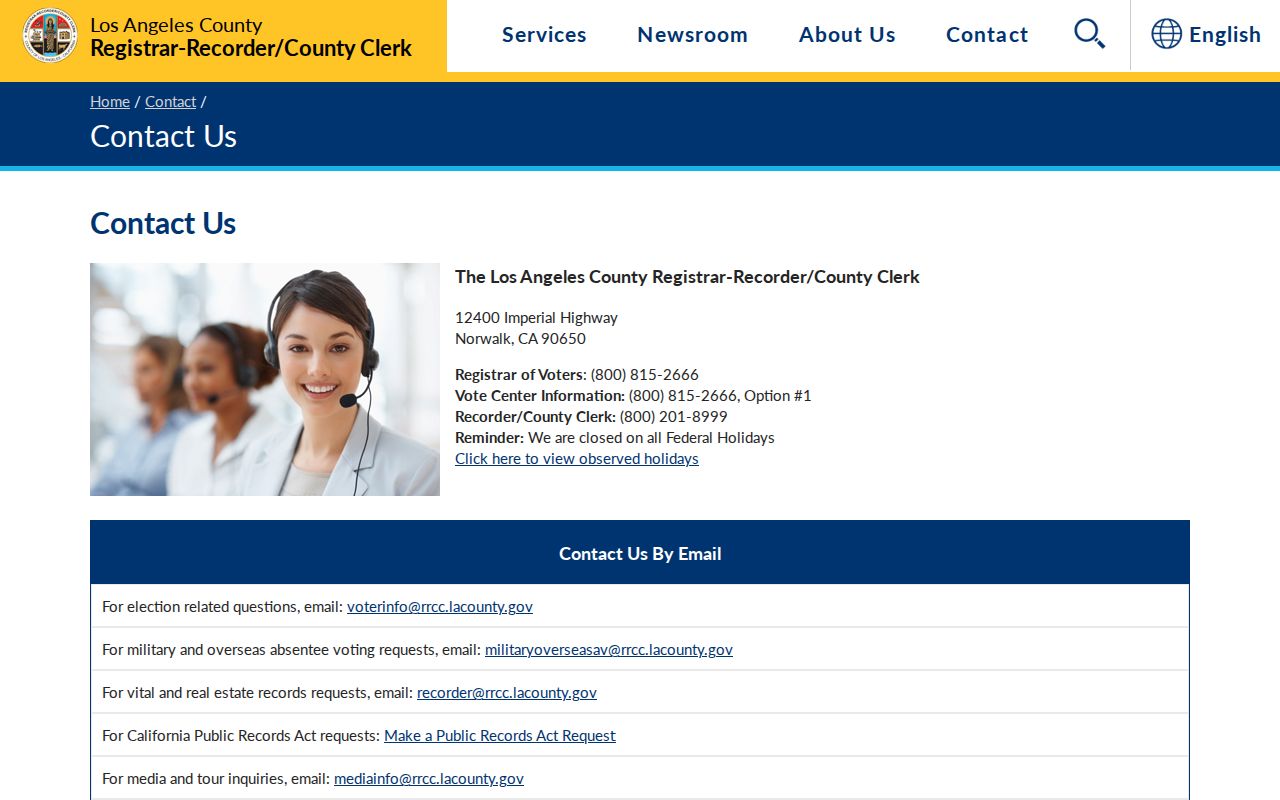
That office route is the counter fallback. Copies cost $5 for the first plain page and $3 for each added page, or $6 certified plus $3 per added page. Staff search is $0.50 per name per year, $1 minimum and nonrefundable. Expedited service is $18.50. A complete document must be purchased.
Note: The page-level “since 1850” and “1851” wording should stay visible when comparing an old El Monte deed trail with the county index.
El Monte Previous Residents in Directory Years
The Los Angeles Public Library catalog lists El Monte holdings that can add occupants, spouses, occupations, and address changes. 35mm microfilm: 1920, 1922-1928, 1930-1932, 1935, 1937, 1939. 16mm: 1940, 1946, 1950, 1955, 1956, 1958, 1960/61. Most is shelved under Alhambra, except 1920 on California reel 2, item 1.
Paper: 1884-85, 1920, 1940, 1946, 1948, 1950, 1953, 1955, 1958 in two copies, and 1988. Free digitized volumes: 1881-82, 1883-84, 1884-85, 1886-87. Regional reverse editions: 1906, 1927, 1956-1987. Check inclusion edition by edition; publishers and a continuous local run are unverified.
Use the El Monte city directory collections for the shelf and format details, then copy the entry exactly. A printed entry may give a surname, given name or initial, spouse in parentheses, occupation, employer, and home address. “r” and “h” can mark residence or householder, while “wid” may mark widow status. The abbreviation page for each volume controls the meaning.
Absence is not proof of a move. It may reflect a missed scan, nonpublication, limited coverage, an address change, or an Alhambra regional heading.
El Monte Previous Residents in Census Records
Federal census schedules add household structure that a deed cannot show. As of 2026, schedules through 1950 are public under the 72-year rule; 1960 is due in 2032. The 1930, 1940, and 1950 schedules can bridge directory gaps, though older entries may use township, precinct, or unincorporated-district labels.
Pair sources in a fixed order so a similar name does not become a false match:
- Copy the address, names, spouse or associate, and occupation.
- Search the nearest public census year with township and precinct variants.
- Compare relationships, ages, occupations, and nearby households.
- Check the next directory for number, street spelling, and name form.
- Use deeds, probate, or an obituary to test a change.
The National Archives census guidance explains the release boundary. A census entry is one household at one moment, not a deed or full list of people tied to land.
Note: Pre-incorporation El Monte can be easier to find through the enumeration district and nearby households than through the modern city name alone.
El Monte Previous Residents: House Maps and Dates
Maps and permits can show when a structure or street context changed, even when no directory names the household. LAPL describes a regional house-history method that combines directories, permits, Sanborn maps, assessor and deed sources, probate, and obituaries. Its Sanborn coverage is generally 1867-1970. The Library of Congress has six El Monte sheets dated May 1920. They can show a footprint, material, height, use, and openings, but not every occupant.
Historical USGS El Monte quadrangles are listed for 1926, 1948, 1953, and 1966. They help place roads, development, and boundaries around the parcel. El Monte Building, Planning, Code Enforcement, Licensing, and Public Works divisions hold different address-keyed files. Building is 626-580-2050, Planning is 626-258-8626, Code Enforcement is 626-580-2080, Licensing is 626-580-2031, and Public Works is 626-580-2058. Ask with the exact address or AIN, record type, and date range.
The city CPRA form requests a date, requester details, a record description, and a month/year range. Inspection is free. Copies cost $0.15 per page after the first ten pages. Permit files may name an applicant, contractor, architect, job-site contact, work description, valuation, issue or final date, and inspection history. Those roles are evidence about a project, not proof of who lived at the address.
The LAPL Sanborn atlas guide is the source-linked route for map research. Use a map footprint to test a building-era claim, then use the parcel and deed records to test the people connected to it.
El Monte Addresses Before Incorporation
El Monte incorporated in 1912. Earlier records may describe the same place through Los Angeles County, El Monte township, a precinct, a rural route, or another unincorporated district. The city history dates the first U.S. pioneer family to 1851, El Monte township to 1866, the change from Lexington to El Monte to 1868, and Southern Pacific tracks to 1873. Search “Lexington” for the earlier name and do not assume a pre-1912 city file exists.
This jurisdiction shift matters when an old deed, census sheet, directory, newspaper, or permit uses a label that no longer appears in a modern address search. Nearby households and enumeration-district maps can help place the record. The Norwood service area also passed from an unincorporated setting through annexation in the early 1960s, a reminder that a modern El Monte label may be newer than the record trail.
The El Monte Cultural Resources Element supplies the dated local history used for these search labels.
Past El Monte Households, Not Just Owners
Previous residents can mean owners, household members, boarders, or people named only in a directory or census. The deed chain answers who held recorded title. The Assessor describes the parcel. A city permit may name the person who applied for work. A directory or census may name the people present at the address. Each source has a different role, and none should be stretched into a complete occupant list.
For a clean house history, keep a date beside every name, preserve the exact spelling, and note whether the entry came from title, parcel, directory, census, permit, obituary, or probate. Mark a gap as unverified. Test street-number changes with the AIN, tract, lot, and legal description. Do not fill a missing household by guessing from a name that appears in a nearby record.
When a title trail ends at a death, probate can explain the next transfer. Wills are filed with the Los Angeles Superior Court, not the recorder. Public probate filings may name a decedent, representative, or heirs. Obituaries, cemetery records, and family collections can supply leads, but the property link still needs a deed, parcel identity, or court record. Use the Los Angeles Superior Court records route for probate access.
Lawful house history. El Monte previous-resident research is suited to family history, estate work, and personal curiosity. Public records do not authorize stalking, tracking, intimidation, or harassment of a living person.
That distinction keeps a title trail, an occupant trail, and a local history trail useful without turning any one of them into a claim they cannot support.