
El Monte City Directory Collections
Verified El Monte holdings are not one smooth run. LAPL catalogs the city under more than one shelf label and format, while regional reverse directories must be checked edition by edition. The years below are the useful starting set. No publisher name should be added until a title page or authoritative catalog record confirms it.
| Collection | Years | Where held | Access |
|---|---|---|---|
| 35mm El Monte microfilm | 1920; 1922-1928; 1930-1932; 1935; 1937; 1939 | LAPL Central Library History & Genealogy; shelved under Alhambra except 1920 California reel 2, item 1 | Microfilm drawers |
| 16mm El Monte microfilm | 1940; 1946; 1950; 1955; 1956; 1958; 1960/61 | Microfiche drawers below call no. NH 973.03 C5815; 1940 roll 31, others roll 104 | Microfilm or fiche access |
| Paper El Monte volumes | 1884-85; 1920; 1940; 1946; 1948; 1950; 1953; 1955; 1958 (two); 1988 | LAPL paper holdings; 1884-85 under Los Angeles City and County directory, 1988 under Alhambra | In-person reference access |
| Digitized El Monte volumes | 1881-82; 1883-84; 1884-85 | LAPL Digital Library and ResCarta | Free online collection |
| Regional reverse directories | 1906; 1927; 1956-1987 | LAPL ResCarta and regional holdings | Check El Monte in each edition |
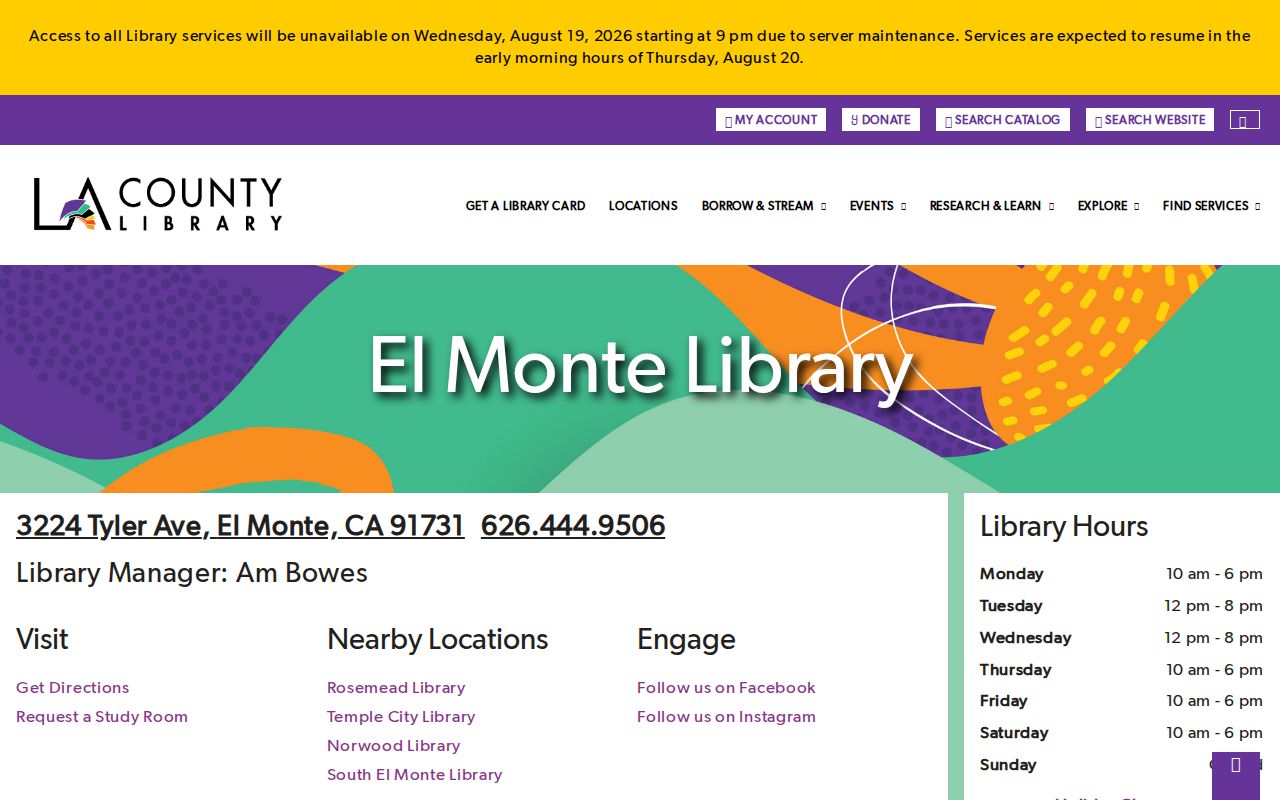
The El Monte Library location and services page is a practical local inquiry route for shelf leads, library resources, and referrals.
The catalog also displays nearby regional material, and a broader digitized screen may surface an 1886-87 volume. Count that year only after the pages confirm El Monte coverage.
Norwood El Monte Library Records Timeline
Norwood Library gives the El Monte city directory search a useful local timeline. Its branch history also explains why an older address may be described through county or unincorporated geography before later city records use the same street label.
- November 22, 1950: the first Norwood storefront opened at 4772 Peck Road.
- Early 1960s: the service area went through annexation.
- 1967: land was purchased for a later branch site.
- April 15, 1977: the current building opened.
- 2026: Norwood is listed as temporarily closed for renovation, with users directed to another branch and the Digital Library.
The Norwood Library history page links La Historia Society and the El Monte Historical Museum.
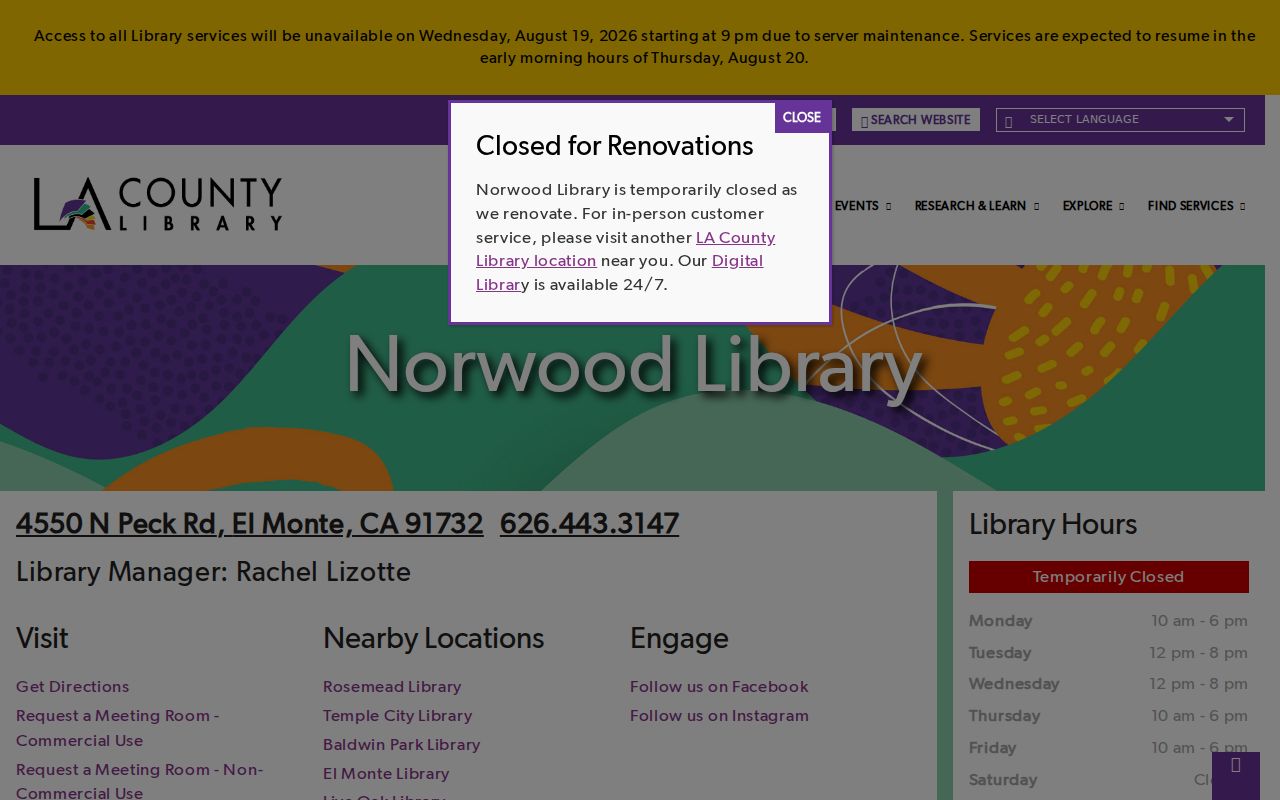
Those local institutions may hold photographs, oral histories, school material, and family collections that do not appear in a county index.
Search El Monte Directories and Alhambra
LAPL catalog searching is more precise than a single keyword box. The captured fields are Keyword, City or Community, County, State or Province, and Region. Each field supports an AND, OR, or NOT selector. Catalog help documents & for all terms, / for alternatives, and * for truncation.
- Use City or Community for El Monte, then repeat the search with Alhambra.
- Use Keyword for a surname, street term, or directory phrase.
- Use County, State or Province, and Region to narrow a broad regional result.
- Read the catalog note before assuming a regional reverse volume includes every El Monte address.
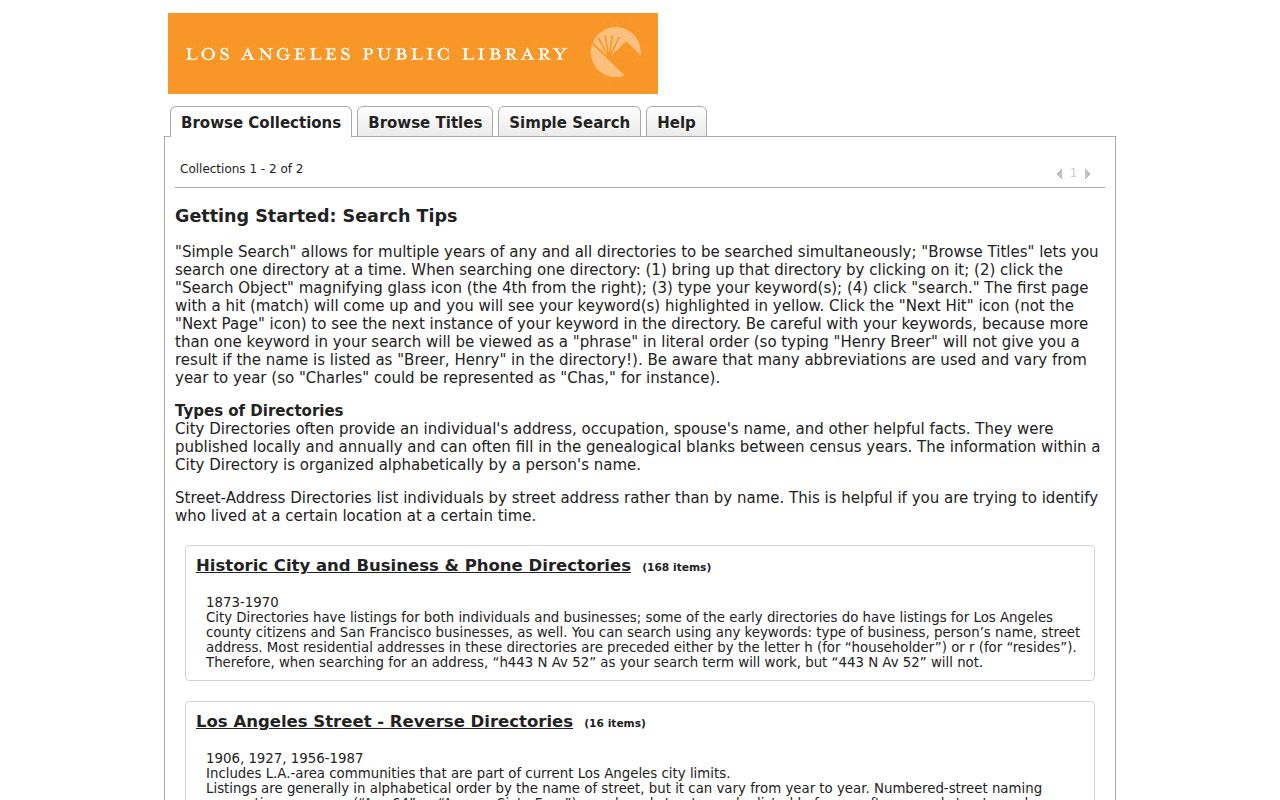
The LAPL digitized city and street directory collection is the route to the online shelf.
The collection is useful for an early name or address lead, but an image must still be read in its own volume context.
The LAPL catalog search-fields reference records the Keyword, City or Community, County, State or Province, and Region choices described above.
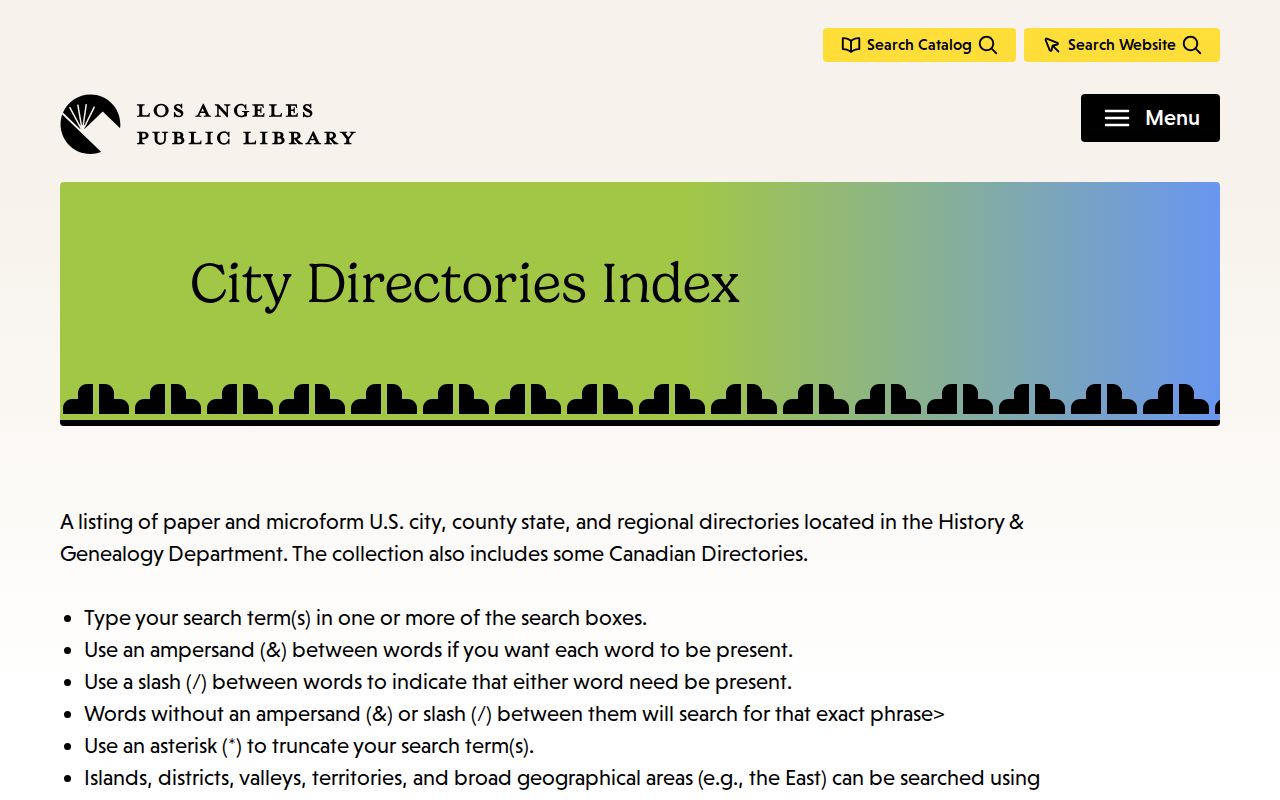
Those fields help separate an El Monte city directory result from a broader regional shelf result.
The LAPL ResCarta browser carries the digitized collection and supports page-level browsing.
Search both city labels because most dedicated El Monte material is physically cataloged under Alhambra.
Read an El Monte City Directory
A city directory entry is a compact record, not a full household census. The usual line can combine identity, work, relationship, and address clues. Exact marks vary by volume, so photograph or transcribe the abbreviation key before reading a long run of entries.
| Name | Surname and given name or initial; a spouse may appear in parentheses. |
|---|---|
| Occupation | Occupation, employer, or business cross-reference when printed. |
| Address | Home address; r may mean resides and h may indicate householder or home. |
| Owner or renter mark | Some runs use a mark, but it is not universal and must be checked in that volume. |
| Widow notation | wid may identify a widow or a deceased spouse reference. |
- Criss-cross section
- A street-order portion that reverses the usual name arrangement into house number, street, and published occupant.
- Householder index
- A name-to-household pointer when a volume supplies one; it does not guarantee that all occupants are listed.
- Abbreviation key
- The volume’s explanation of short marks such as
r,h, orwid; verify it before copying meaning. - Business entry
- A separate listing for a shop, firm, or office that may share a street address with a residence.
No authoritative named El Monte entry was opened during the research capture. A surname, street, or occupation should not be invented as a sample; use a real page image or the volume itself.
El Monte Reverse Directory Sections
Reverse directories turn an address into a historic published occupant, but the regional holdings are not a guaranteed continuous El Monte run. The verified years are 1906, 1927, and 1956-1987 edition by edition. A number missing from one volume may reflect a coverage choice, a vacant parcel, a changed street number, or a scan or print convention.
Read the street in sequence. Copy the street spelling, house number, occupant mark, and any business indicator. Then compare the result with a same-year city directory, census schedule, permit, deed, or obituary. The reverse entry is an address clue. It does not establish title, every household member, or a current address.
For current parcel work, the El Monte street directory address chain begins with the Assessor AIN rather than a reverse volume.
Trace El Monte Families by Year
Household tracing works when each directory year is treated as one dated observation. Start with a known name, address, or event. Keep the exact spelling and record what disappears as carefully as what appears.
- Find the first plausible directory year and copy the name, address, spouse note, occupation, and any mark exactly.
- Search nearby editions, including spelling, married or maiden, compound surname, and initial variants.
- Use a reverse section, when present, to check the same house number and nearby entries.
- Pair directory years with the 1930, 1940, and 1950 federal census schedules to compare household composition.
- Close a late gap with a probate file, obituary, deed, or other record that can explain an inheritance, move, or death.
An absence can mean a missed scan, a publication gap, a coverage limit, a name change, or a move. It is not by itself proof of death. El Monte names also need careful handling across Spanish surname order, married or maiden forms, Chinese name-order or romanization variants, and initials.
El Monte Census Pairing
Federal population schedules are released after 72 years. As of 2026, schedules through 1950 are public; the 1960 schedule is scheduled for release in 2032. Use the census to test a directory line against household relationship, age, occupation, and place, while remembering that the two sources may use different enumeration geography.
The National Archives census research route explains the public release and access context for the schedules. Census QuickFacts for El Monte is a separate current-demographic reference, not a household name index.
Before incorporation, an El Monte household may be cataloged under township, precinct, or an unincorporated district rather than the later city name. Enumeration-district maps and neighboring households can be more reliable than a modern place label.
Map El Monte House History
The Los Angeles Public Library’s regional house-history workflow joins city and telephone directories with building permits, Sanborn maps, Assessor and deed sources, probate, and obituaries. That sequence helps answer two separate questions: who was published at an address, and how the parcel or building changed.
The LAPL house-history guide provides the regional method.

The guide’s Sanborn database covers 1867-1970 generally, but exact El Monte sheets must be verified in the database.
The LAPL Sanborn atlas guide explains how maps show building outline, material, height, use, and openings.
The Library of Congress also supplies a free six-sheet El Monte Sanborn map dated May 1920. USGS El Monte quadrangle holdings are listed for 1926, 1948, 1953, and 1966. Maps add place and building context, not a complete occupant list.
The Library of Congress El Monte map record is a useful map check when a directory address needs a physical setting.
Before El Monte Incorporated
El Monte incorporated in 1912. Earlier people and places may sit in county, township, precinct, church, land, newspaper, or federal sources. The city’s historical labels changed over time, so a city directory search needs older place names as well as the modern one.
- 1851: the city history identifies the first U.S. pioneer family.
- 1866: El Monte township appears in the local historical timeline.
- 1868: the name changed from Lexington to El Monte.
- 1873: Southern Pacific tracks added a major local geographic anchor.
- 1906 and 1907: Main Street paving and Pacific Electric Red Cars changed the built setting before incorporation.
- 1912: incorporation created the later municipal label, but older records keep their original geography.
Include Lexington and township or precinct terms in catalog, newspaper, and census searches when the household predates the city label.
El Monte Directory Gaps
El Monte’s city directory shelf is valuable because it is uneven. Verified years do not create a continuous annual run, and the research did not identify authoritative publishers for the twentieth-century editions. Library and museum staff can help locate a title or year that is not visible in an online finding aid. Norwood’s 2026 renovation closure also changes the in-person route, so branch access should be checked before a visit.
When a directory stops, bridge the gap with census schedules, USGS or Sanborn maps, permits, recorded instruments, probate, and obituaries. A directory can place a published household at a date; a deed can place a named party in a title chain; probate can explain an estate transition. Keep those functions distinct.
Note: A missing El Monte city directory year is evidence of a shelf or coverage gap until another source shows what happened to the household.